Translate

Search This Blog

Showing posts with label Finance. Show all posts

Monday, August 31, 2026

The Crucible: How the War in Ukraine is Rewiring Global Security, Europe, and the Modern Economy

Walk down the streets of Kyiv or Lviv on a typical August day, and you’ll notice something heavy in the air. This week marked Ukraine’s 35th Independence Day, but there were no large celebrations, no parades, and no festive gatherings. Instead, the quiet streets reflect the profound human toll of a conflict that has completely transformed the national landscape.

When Russia’s full-scale invasion shattered the peace in February 2022, many hoped it would be a short-lived territorial dispute. More than four years later, it’s painfully obvious that this war is something much bigger. It has become a brutal, defining struggle over the future of the international order, the limits of Moscow’s geopolitical reach, and whether the global community can actually stand up and defend national sovereignty.

For Europe, the illusion that economic trade could permanently replace military deterrence is dead and gone. The continent is waking up to a hard reality, turning Ukraine into the ultimate strategic testing ground for modern warfare. From rebuilding defense industrial bases to hardening critical infrastructure against sabotage, Europe is bracing for a high-intensity future.

And the ripple effects? They’re touching everything—from global trade routes and energy markets to the daily cost of living for everyday people.

Tuesday, August 25, 2026

The Economic D‑Day Against Iran

When President Trump first talked about launching an “economic D‑Day” on Iran, many shrugged it off as campaign rhetoric. 

Six months later, after the joint U.S.–Israeli strikes of February 28, 2026, that rhetoric turned into a full‑blown financial offensive. Today, the sanctions regime looks less like a diplomatic tool and more like a siege designed to choke off every dollar that keeps Tehran’s economy breathing.

In plain language, the United States has turned the financial system into a weapon. By cutting off access to SWIFT, freezing assets, and threatening any third‑party that does business with Iran, Washington hopes to force Tehran back to the negotiating table or, as critics argue, to cripple the regime’s ability to fund its military and proxy networks.

Saturday, August 22, 2026

Who Really Wins When the Shooting Starts? (Spoiler: It’s Not Always the Armies)

Let’s be real for a second. When tensions flare between countries like the US and Iran, our first question is almost always: Who won? Who lost? Did Washington achieve its goals? Did Tehran hold its ground? It’s human nature to seek a clear scoreboard.

But here’s what keeps me up at night and what the analysts scrolling through Bloomberg terminals at 2 AM already know: that scoreboard tells only half the story. The real, often quieter, story of modern conflict isn’t just about flags raised or territory gained. It’s about who’s quietly ringing up sales while the headlines scream about troop movements and missile strikes.

Think about it. When the Strait of Hormuz feels tense, when drones patrol the Gulf, when diplomats trade barbs instead of treaties… money doesn’t just stop flowing. It redirects. And sometimes, it flows straight into the pockets of industries you wouldn’t expect to see thriving on instability.

Thursday, August 20, 2026

‘Tremendous Consequences’: Trump’s New Economic Blitz on Iran – What It Means for the World

It’s been just over six months since the first shots rang out between the U.S.–Israel coalition and Iran on February 28, 2026. The Strait of Hormuz, that narrow choke‑point through which roughly a fifth of the world’s oil sails, remains heavily disrupted.

Washington, D.C. – President Donald Trump took to Truth Social early this morning (August 20) to unveil what he calls the “MOST CRUSHING ECONOMIC OPERATION EVER TAKEN AGAINST ANY COUNTRY.”

Tehran – Iranian officials continue to defy the pressure, insisting their missile and drone capabilities keep the strait “closed enough” to hurt global markets.

Abu Dhabi – The UAE announced yesterday that it is suspending all economic ties with Iran after two Iranian ballistic missiles struck near its offshore facilities.

Strait of Hormuz – U.S. naval escorts are still guiding 15‑20 vessels each night, moving roughly half the pre‑war oil volume, but the flow is far from normal.


In short, the conflict is entrenched, the economic front is heating up, and the November 2026 U.S. elections loom large over every decision.

Wednesday, July 1, 2026

Trump Crypto Windfall: Over $1 Billion in 2025 Digital Asset Deals Reshape Presidential Income

A Deep Dive Into The President's Financial Disclosure and the Crypto Boom

Discover how President Trump generated over $1 billion from cryptocurrency deals in 2025, according to official financial disclosures. Full breakdown inside.

The intersection of politics and cryptocurrency has never been more lucrative or more controversial. President Donald Trump's latest financial disclosure has revealed something that would have seemed impossible just a few years ago: more than $1 billion in income from crypto-related ventures in a single year.

Let's break down what this means, how it happened, and why it matters for both the political and financial landscapes as we move through 2026.

Thursday, June 25, 2026

Behind Diplomatic Smiles: Deep Frustration Grips UAE Over US Actions in Iran War

Just over a year ago, the United Arab Emirates was riding high on a wave of optimism. Donald Trump's second term brought promises of massive investment deals $2 trillion worth, by some accounts and the relationship between Abu Dhabi and Washington seemed stronger than ever. The Emirati leadership positioned itself as America's closest Gulf partner, a strategic ally in a region often described as the world's most volatile neighborhood.

Today? That optimism has curdled into something much darker.

Behind the carefully choreographed handshakes and public displays of diplomatic solidarity at the G7 summit in France, where UAE President Mohamed bin Zayed al-Nahyan offered his formal thanks to Trump, there's a growing sense of betrayal rippling through the Emirati establishment. Business leaders, former officials, and ordinary residents are asking the same uncomfortable question: How could our closest ally drag us into a war we explicitly warned them not to fight?

Saturday, June 13, 2026

Elon Musk Just Became the World's First Trillionaire — And He's Left Everyone Else in the Dust

A New Era of Wealth: What $1.1 Trillion Actually Looks Like

Let's be honest when we talk about billionaires, we're usually counting zeros. But what happens when someone crosses into uncharted territory? Elon Musk just did exactly that.

According to the latest Bloomberg Billionaires Index, Musk's net worth has reached an eye-watering $1.11 trillion, officially making him the world's first trillionaire. And here's the wild part that's roughly equivalent to the combined fortunes of the next four richest people on the planet.

Think about that for a second.

While most of us are calculating whether we can afford a coffee price hike, Musk is out here accumulating more wealth than some countries' entire GDPs. It's almost surreal, right?

Tuesday, May 26, 2026

How Much Is the 2026 Iran War Costing America? Here’s the First Big Number: $29 Billion

The pentagon has spoken, and the number is staggering. America's military involvement in the 2026 Iran conflict has already cost U.S. taxpayers $29 billion dollars, and that's just the beginning. 

This preliminary figure, released by defense officials in recent weeks, offers the first concrete glimpse into the financial scope of what many analysts are calling the most expensive military engagement in the Middle East since the wars in Iraq and Afghanistan.

But what does this $29 billion figure actually cover? Where is the money going? And perhaps most importantly for American families watching their tax dollars flow overseas is this just the tip of the iceberg?


Breaking Down the $29 Billion Price Tag

The Pentagon's initial estimate encompasses several major categories of expenditure that might surprise the average American. Deployment costs alone account for a significant portion, including the transport of personnel, equipment, and supplies across continents to a region that sits roughly 7,000 miles from Washington, D.C. When you factor in the repositioning of carrier strike groups in the Persian Gulf, the establishment of forward operating bases, and the logistical nightmare of maintaining supply lines in a hostile environment, the numbers start to make sense.

Saturday, May 2, 2026

How Iran Moves Billions in Crypto, Even in a Blackout

Discover how Iran's largest crypto exchange, Nobitex, moves billions and bypasses sanctions. Learn about its powerful founders, its role for both the state and citizens, and how it thrives even during internet blackouts.


Imagine trying to send money abroad, but your country is cut off from the global financial system. International banks won't touch you. SWIFT transactions are blocked. The world has put up a formidable wall of sanctions.


Now, imagine a digital backdoor.


For Iran, that backdoor isn't a secret. It’s the country's largest cryptocurrency platform: Nobitex. And its story is straight out of a financial thriller, blending tech innovation with high-stakes geopolitics.

Tuesday, May 10, 2022

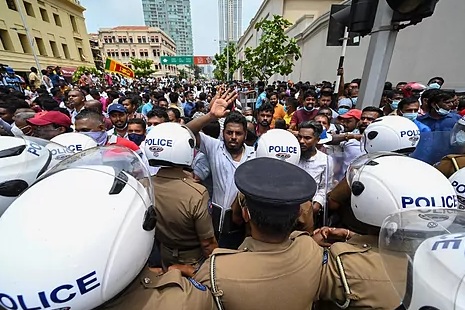
From Scarcity To Protests: Sri Lanka Decrees Curfew After Violent Demonstrations

At least five people died in clashes in the streets. Although the prime minister resigned, hundreds of protesters tried to enter his house, for which he had to be evacuated.

In a matter of weeks, the tranquility has been definitively shattered in this small island country in South Asia. The serious shortage of food, fuel and medicine has generated enormous discontent among the population, which blames the powerful Rajapaksa clan for the crisis.

On Tuesday, Sri Lankan authorities deployed thousands of soldiers and police to enforce a nationwide curfew after five people were killed in renewed protests.

Thursday, December 2, 2021

Inflation in Turkey And "Great Master" Recep Tayyip Erdogan Pressure

Recep Tayyip Erdogan exchanges finance minister again

In the midst of a serious currency crisis, the Turkish president separates from his finance minister. He was only in office for a year.

Turkish President Recep Tayyip Erdogan is under pressure because the national currency is falling. He is trying to counteract this with a change in personnel: Finance Minister Lütfi Elvan will be replaced by Nureddin Nebati, according to an official announcement. Elvan had only held the office since November 2020, when he was appointed finance minister following the resignation of Erdogan's son-in-law Berat Albayrak.