Translate

Search This Blog

Showing posts with label Sri Lanka. Show all posts

Tuesday, May 10, 2022

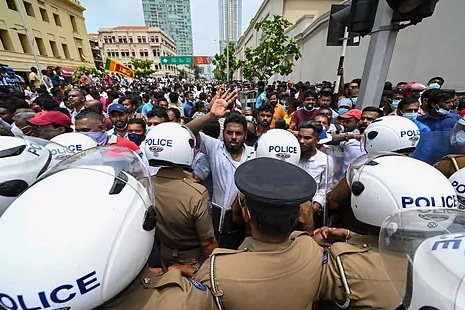
From Scarcity To Protests: Sri Lanka Decrees Curfew After Violent Demonstrations

At least five people died in clashes in the streets. Although the prime minister resigned, hundreds of protesters tried to enter his house, for which he had to be evacuated.

In a matter of weeks, the tranquility has been definitively shattered in this small island country in South Asia. The serious shortage of food, fuel and medicine has generated enormous discontent among the population, which blames the powerful Rajapaksa clan for the crisis.

On Tuesday, Sri Lankan authorities deployed thousands of soldiers and police to enforce a nationwide curfew after five people were killed in renewed protests.

Thursday, April 25, 2019

Sri Lanka | ISI responsible for attacked “The commando Brothers in Sri Lanka”


Nine bombers perpetrated devastating attacks on Christian churches and hotels in Sri Lanka, killing 359 people

Eight of them were identified, among them a woman, said Deputy Defense Minister Ruwan Wijewardene on Wednesday. The mass murderers had sworn allegiance to IS leader Abu Bakr al-Baghdadi before their atrocities, according to a video distributed by the propaganda agency Amaq. In addition, the IS threatened in another message that attacks as in Sri Lanka "will be repeated in the US, Britain and France."

The suicide bombers were wealthy and had studied abroad. Most of them were educated and belonged to the upper middle class, said Vice-Defense Minister Wijewardene. One of the assassins had probably studied in the UK and Australia and then returned to Sri Lanka. Even a well-known hate preacher should have been among them. The police had announced Wednesday that they had raided another 18 suspects in another raid. Thus, the number of arrested in connection with the attacks increased to a total of 58.
Attacks were almost simultaneous

Seven Sri Lankan assassins blew themselves up almost simultaneously on three Sundays in three churches in several cities and in three luxury hotels in the capital, Colombo. Another attempt on a five-star hotel failed. A few hours later, there were two more explosions in a small hotel and a residential building in the suburbs of Colombo. According to police, the eighth explosion killed the woman, two children and another relative of one of the assassins and three policemen. The number of deaths was according to police from Wednesday at 359 - among them more than 30 foreigners. More than 400 injured were still treated in hospitals.

The situation remains tense

The situation in Sri Lanka is particularly tense in the capital Colombo. Heavily armed security forces are patrolling the streets. Wednesday morning, another explosion in front of a movie theater caused a stir, and a short time later, the police confirmed that a suspiciously parked scooter had been blasted in a controlled manner. The police also warned people in the streets via loudspeakers of suspicious vehicles or parcels.


USA: "Did not know anything about it in the run-up" Meanwhile, the
US denied having prior knowledge of the planned attacks in Sri Lanka. "We did not know about these attacks," said US Ambassador Alaina Teplitz to the US television channel CNN on Wednesday. At least four US citizens were killed in the bombings.


A Sri Lankan minister said earlier this week that India and the US had given information to his government before the attacks. Ambassador Teplitz now denied this: "I do not know what other sources of information the Government of Sri Lanka has. I can only say that we had no previous knowledge, "she told CNN. The government of Sri Lanka has admitted errors in collecting and sharing intelligence information.
Investigations on further IS connections 

The IS had claimed the attacks on Tuesday for itself. Possible IS connections are still under investigation, said Wijewardene. The government had blamed a little-known indigenous Islamist group for carrying out the attacks with foreign aid. As a motive, the government suspected retaliation for the attack on mosques in Christchurch, New Zealand, in March. There could still be suspects at large, Wijewardene said. "We ask people to be vigilant."

Monday, April 22, 2019

Updated about Sri Lanka | 300 People and 500 Injured in Bloody Terrorist Attack


Explosions in three churches and four hotels in the Asian island state killed nearly 300 people and injured some 500 more

Among the victims were also over 30 foreigners, police said. Initially no one confessed to the incidents, and the government reported seven arrests. So far, there are no indications to affected Austrians, but the situation was confusing, it was said on Sunday from the Foreign Ministry on request. The responsible embassy in India's capital New Delhi is in contact with the authorities in Sri Lanka.


The first six explosions, which occurred between 8:30 and 9:00 am local time, were reported in the churches of St. Anthony in Colombo and St. Sebastian in the Negombo town outside the capital. The third church is located in Batticaloa in eastern Sri Lanka. At the time, the faithful were celebrating Easter Mass. At around the same time, bombs had blown up in the three five-star hotels Shangri-La, Cinnamon Grand, and Kingsbury in Colombo.


St. Anthony's Church, dedicated to St. Anthony of Padua, is considered the national sanctuary of the Catholics of majority Buddhist Sri Lanka. 6.1 percent of the island's 22 million inhabitants are Catholics.


Dead in two more explosions 
A few hours later, there was another explosion in a hotel in Colombo, where at least two people died according to police. According to a BBC reporter, the bomb in the suburb Dehiwala detonated. An eighth explosion occurred in the afternoon (local time) in a residential area in Dematagoda, another suburb of the country's capital. There, a suicide bomber ripped three policemen to death.


Dozens of aliens among the dead
Sri Lanka's Minister for Economic Reform, Harsha de Silva, wrote on Twitter of numerous victims, including eighteen foreigners - according to hospital information, Americans, British and Dutch. The Portuguese news agency Lusa also reported a Portuguese victim. Sri Lanka's Ministry of Defense issued a twelve-hour, nationwide curfew in response to the series of attacks. Access to social networks and messenger services has also been blocked.


Those responsible have already been identified
According to Deputy Defense Minister Ruwan Wijewardene, those responsible for the series of attacks have been identified. He spoke at a press conference about a "terrorist incident" and "extremist groups."

Police chief warned against suicide attacks
The police chief of the country had recently warned of possible suicide attacks on churches and on the Indian High Commission by the radical Islamic group NTJ. He relied on information from a "foreign intelligence service". The attacks are the worst since the end of the civil war ten years ago.


Prime Minister: "Condemn the cowardly assassinations"
"I condemn the cowardly assassinations today on our population," wrote Prime Minister Ranil Wickremesinghe on Twitter. The armed forces and the police would investigate the "conspiracy". He called on all the inhabitants of his country to be united and strong in the face of the tragedy. The spread of speculation and unconfirmed reports must be avoided, the head of government appealed to the population. The government is taking all necessary steps.


Island state popular destination of tourists
The South Asian island state is a popular tourist destination, also for Europeans. Only seven percent in the majority of Buddhist Sri Lanka are Christians. They include members of the Tamil minority and Sinhalese majority.


Civil War ended in 2009
Sri Lanka's 26-year civil war ended in 2009 . The Liberation Tigers of Tamil Eelam (LTTE) rebel group fought for an independent Tamil state in the north of the country. The army finally defeated the insurgents with all severity. The United Nations accuses both sides of war crimes.

Friday, January 11, 2013

CONTROVERSY | The woman was convicted of murder Sri Lanka withdraws its ambassador to Saudi Arabia after the execution of an employee


Sri Lanka has recalled its ambassador to Saudi Arabia after the execution by beheading of a maid of nationality by the death of a child who was in charge in 2005, according to the government. Rizana Nafeek was beheaded in Dawadmy city near the capital Riyadh after being sentenced to death in 2007. He was accused by her Saudi employer killing his newborn daughter while she was giving him a bottle. "We want to show our displeasure by not listening to the government's appeal to save Rizana Nafeek" said Karunatilake Amunugama, Secretary, Ministry of Foreign Affairs. The Sri Lankan government appealed against the conviction, but the Supreme Court upheld the ruling Saudi Arabia in 2010. The child's mother rejected the request to forgive the employee, which is the most important criterion when considering the release of a murderer in Saudi Arabia, said a senior official of the government of Sri Lanka, speaking on condition of anonymity. The Saudi Interior Ministry said the baby was strangled after a dispute between the maid and the baby's mother. Hundreds of women in Sri Lanka's capital, Colombo, protested against the execution of Nafeek and criticized the government should have done more to demand her release. He expects more protests on Friday. The mother of the employee has asked the government to help you bring your body back to Sri Lanka, according to local media. However, government officials said they had been buried in Saudi Arabia. Usually households are highly dependent on Saudi domestic workers from countries in Africa and South Asia. There have been reported cases of domestic abuse in families that abuse their employees and then they attacked the children of their employers. The NGO Human Rights Watch has condemned the execution and said Nafeek was a victim of the deficiencies in the judicial system in Saudi Arabia. In the country, a U.S. ally, an absolute monarchy ruled that follows the strict Wahhabi school of Islam. Judges decisions based on their own interpretation of sharia, or Islamic law, rather than a written legal code.