Translate

Search This Blog

Showing posts with label Arms Deal. Show all posts

Thursday, June 25, 2026

Behind Diplomatic Smiles: Deep Frustration Grips UAE Over US Actions in Iran War

Just over a year ago, the United Arab Emirates was riding high on a wave of optimism. Donald Trump's second term brought promises of massive investment deals $2 trillion worth, by some accounts and the relationship between Abu Dhabi and Washington seemed stronger than ever. The Emirati leadership positioned itself as America's closest Gulf partner, a strategic ally in a region often described as the world's most volatile neighborhood.

Today? That optimism has curdled into something much darker.

Behind the carefully choreographed handshakes and public displays of diplomatic solidarity at the G7 summit in France, where UAE President Mohamed bin Zayed al-Nahyan offered his formal thanks to Trump, there's a growing sense of betrayal rippling through the Emirati establishment. Business leaders, former officials, and ordinary residents are asking the same uncomfortable question: How could our closest ally drag us into a war we explicitly warned them not to fight?

Tuesday, June 9, 2026

Can Trump Bring Peace to the Middle East?

Discover the latest on the Iran-Israel conflict as it passes 100 days. Analysis of Trump's peace efforts, Netanyahu's stance, and what lies ahead for Middle East stability.

The ongoing conflict between Iran and Israel has now passed the 100-day mark, with developments that have left international observers scratching their heads and world leaders scrambling for solutions. What started as a regional dispute has evolved into one of the most volatile situations in the Middle East in decades.


The Situation Today

As of today, the Iran-Israel conflict continues to pose significant challenges to global stability. The past months have seen intense diplomatic maneuvering, with President Donald Trump repeatedly stating that an Iran deal is "imminent" a claim he has now made well over 30 times without a final agreement being reached.

Israeli Prime Minister Benjamin Netanyahu has taken a firm stance, repeatedly asserting that Israel has the right to self-defense. His government has authorized continued operations against Iranian targets, a move that has strained relations even with Israel's closest allies.

"It's a complicated situation," says one Middle East analyst who spoke on condition of anonymity. "Neither side seems willing to back down, yet both claim they want the same thing peace and security."

Monday, June 8, 2026

Iran-Israel Strikes Again And the Middle East Is Spiraling Back Into Chaos

What's really happening at the ceasefire's breaking point. The fragile peace in the Middle East just collapsed again.

For the first time since that shaky ceasefire took effect in April, Iran launched strikes directly at Israel over the weekend. It's been roughly 100 days since the original agreement, and honestly, barely two months into what was supposed to be a real break from the fighting. Now? We're right back where we started or maybe even worse.

Let me break down what's actually going on here, because there's a lot more happening than just the obvious back-and-forth airstrikes.

Monday, June 1, 2026

Trump's Iran Rhetoric: What's Really Driving the Tough Talk?

Is It Israeli Pressure, Political Calculus, Or Something Else Entirely?

Let's be honest here when Donald Trump starts talking tough on Iran, people immediately start looking for explanations. And lately, there's been plenty of chatter about what's actually behind the president's sharp words. Some officials in Tehran have pointed the finger directly at the Israeli lobby, claiming it's driving Washington's harder line. Meanwhile, here's the thing: the situation on the ground is honestly more complicated than either side is letting on.

So what's really going on? Is Bibi pulling strings in the Oval Office, or is this just good old-fashioned political theater? Let's unpack this together.

Sunday, May 24, 2026

The Strait of Hormuz: Why This Chokepoint Remains the World's Most Dangerous Flashpoint

Discover why the Strait of Hormuz remains the world's most dangerous flashpoint. Analysis of Iran-US tensions, strategic control, and what it means for global oil markets in 2026.

Let me be direct about something that doesn't get nearly enough attention: the Strait of Hormuz is perhaps the most strategically important piece of real estate on Earth, and everyone from Washington to Tehran knows it. 

No matter what Donald Trump is planning or what any future administration might contemplate Iran has demonstrated, time and again, that it can inflict severe disruption on global energy markets through its chokehold over this narrow shipping lane. And while successive U.S. presidents have managed to limit the economic pain so far, the fundamental math of the situation hasn't changed. One country controls the to a waterway through which roughly one-fifth of the world's oil passes. That's not a problem you solve with tougher rhetoric or even sanctions. It's a structural vulnerability that has defined Middle East geopolitics for decades.

I want to unpack why this matters so much, how we got here, and what the future might hold because understanding the Strait of Hormuz isn't just academic. It affects your gas prices, global markets, and potentially whether the world falls into recession. And no matter how powerful the United States military happens to be, there are some geographical realities that cruise missiles simply cannot change.

Saturday, May 23, 2026

Rising Tensions: Pentagon Updates Military Readiness as Trump Administration Weighs Iran Strikes Alongside Diplomatic Path

The situation between the United States and Iran has entered one of its most precarious phases in years. Behind the scenes at the Pentagon and across multiple government agencies, there's a familiar but unsettling buzz of activity. 

Military planners are revisiting target folders that haven't been touched in earnest for quite some time, while diplomats simultaneously keep communication lines open in hopes of avoiding an all-out confrontation.

The Trump administration, according to multiple sources, is actively preparing for the possibility of new military strikes against Iran but no final decision has been made yet. This isn't just rhetorical posturing from Washington. On the ground, the practical implications are already becoming visible. U.S. officials have begun updating military readiness levels across several installations in the Middle East, and perhaps most tellingly, leave has been canceled for certain personnel units. When the military starts pulling people off planned time away from their families, you know something serious is brewing beneath the surface.

The Intelligence Behind the Preparations

What changed to bring us to this point? The answer lies in a complex web of regional provocations, intelligence assessments, and calculations about what Iran might do next. The administration has been weighing evidence suggesting that Iran or its regional proxy forces were preparing operations that American intelligence deemed unacceptable threats to U.S. interests or personnel in the region.

Wednesday, May 20, 2026

The Middle East on the Edge: Israel, Iran, and the Shadows of War | The UAE's Dangerous Game

The Middle East has never exactly been a place for the faint of heart, but lately, the tension has reached something altogether different a slow-burn pressure cooker that seems perpetually moments away from boiling over. 

According to reports from Times of Israel, Israel is once again dusting off its war plans against Iran, and this time, the stage feels different. The UAE, that gleaming desert powerhouse, has apparently thrown its weight behind Israel, offering bases and logistical support in what can only be described as a dramatic realignment of Gulf politics. Meanwhile, Iran's Revolutionary Guards have delivered a warning to the United States that sounds less like diplomacy and more like a promise: 

"If the US-Israeli enemy attacks Iran again, the war will extend beyond the region."

That's not just posturing. When a military force with the reach and capability of the IRGC starts talking about expanding conflict beyond national boundaries, the entire global community should pay attention.

We've been here before, haven't we? The pattern has become almost ritualistic at this point. Threatened deadlines, whispered negotiations, last-minute phone calls from Gulf capitals, and then... silence. A pause. Another round of talks that goes nowhere. Rinse and repeat. It's enough to make anyone wonder whether this endless dance of threats and ultimatums is actually a strategy or simply the natural state of affairs in a region that has known peace only in brief, uneasy spurts.

Saturday, May 16, 2026

Arab Regimes Playing with Fire: Why Gulf Countries Can't Hide While the House Burns

The old saying goes that when your neighbor's house catches fire, you better start checking your own curtains. 


Yet here we are in May 2026, watching Arab regimes in the Gulf make the same mistake leaders have made for centuries thinking that geography alone will protect them when the flames are spreading fast. The current US-Israel military campaign against Iran has exposed something many of us already suspected: most of these countries aren't regional players anymore. They're spectators watching a war they helped create, hoping somehow they'll escape the blast radius.


Saudi Arabia stood alone in refusing to become a pawn in someone else's war. The kingdom took hits, faced pressure, and still said no. That's not nothing. Meanwhile, countries like the UAE rolled out the red carpet for American and Israeli forces, then tried to tell the world they were just "managing relationships." Let's talk about what's really happening across the Gulf right now, because the narrative being spun in capital cities doesn't match what we see on the ground.

Monday, December 13, 2021

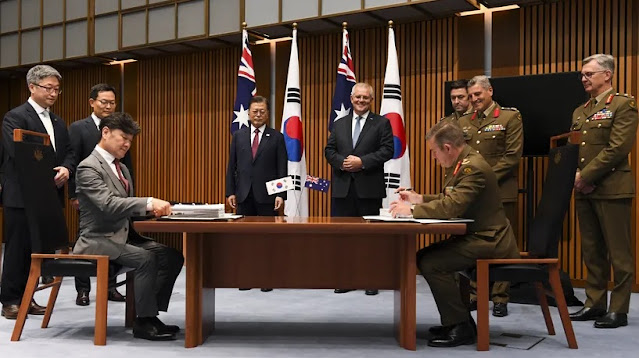
Australia And South Korea Sign Arms Agreements


It is the largest arms agreement between Australia and an Asian country: South Korea is supposed to supply Australia with artillery weapons and radar equipment.


Australia and South Korea have agreed an arms deal worth one billion Australian dollars (around 635 million euros). The deal wassealedduring a visit by South Korean President Moon Jae In to Australia
, the first visit by a foreign head of state to Australia since the pandemic began.

Sunday, December 12, 2021

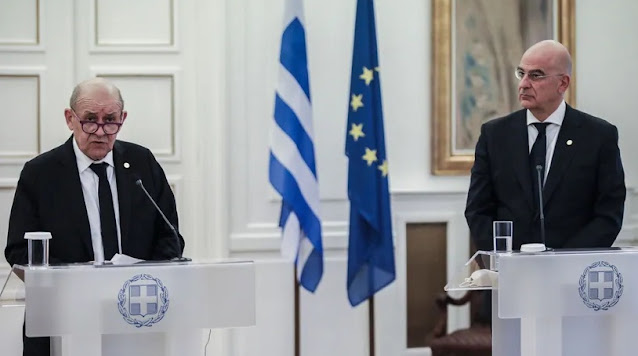
France And Greece Sign Arms Deal

Greece buys three French frigates and rejects a US offer. Recently, another arms deal had caused a dispute between France and the United States.

Greece has signed an arms deal with France and will buy three frigates from the Naval Group, said the French Ministry of Defense. The ships are used for defense and intervention and are scheduled to be delivered to the Greek Navy by 2026. Greece confirmed the deal.