Translate

Search This Blog

Showing posts with label Burma. Show all posts

Saturday, January 15, 2022

Myanmar: New Charges Against Aung San Suu Kyi

The judiciary of Myanmar's military junta is expanding the case against the Nobel Peace Prize winner. You face up to 160 years in prison.

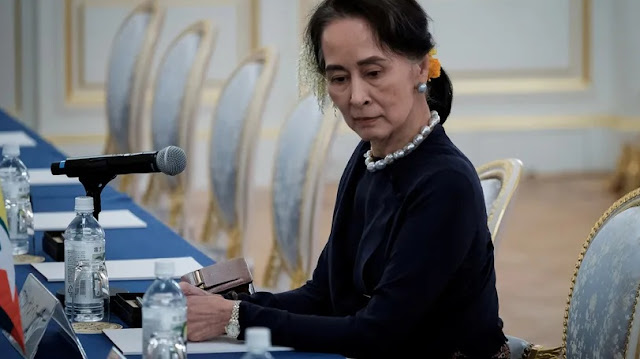
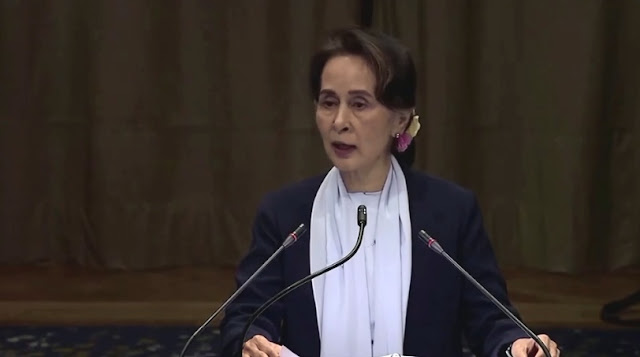
In Myanmar, the judiciary has brought five further charges of alleged corruption against Prime Minister Aung San Suu Kyi, who was ousted in a military coup. This was reported by several media, citing sources familiar with the court case.

Overall, the 76-year-old is now confronted with eleven charges. Ten of these involve violations of an anti-corruption law. According to the information, she faces up to 160 years in prison.

Monday, January 10, 2022

Myanmar: Former Leader Of Myanmar "Aung San Suu Kyi" Sentenced An Additional Four Years In Prison

A court has sentenced the disempowered Prime Minister of Myanmar, Aung San Suu Kyi, to four more years in prison. Among other things, it is about the possession of radios.

Myanmar's disempowered Prime Minister Aung San Suu Kyi has been sentenced to four years in prison by a court.

The 76-year-old was found guilty in two cases of illegal import and possession of walkie-talkies and in one case of violating corona regulations, according to a judicial officer. In connection with the radio equipment, she is said to have disregarded telecommunications and import-export laws.

Friday, November 12, 2021

Burma Court Sentences US Journalist To 11 Years In Prison

He attributes different crimes to Danny Fenster, including violating a law that punishes anyone who tries to delegitimize the military junta.

A court in Burma (Myanmar) sentenced American journalist Danny Fenster to 11 years in prison on Friday for various crimes, including violating a law that punishes anyone who tries to delegitimize the military junta.

According to the Frontier news portal, for which Fenster worked, the journalist has been sentenced to three years for violating said law, another three for illegal association and five years for breaking immigration law.

Saturday, May 22, 2021

Military Junta Orders Dissolution Of Suu Kyi's Party

Burma's Election Commission, appointed by the military junta, announced on Friday the dissolution of the National League for Democracy (NLD) party, led by the deposed Burmese leader, Aung San Suu Kyi .

The director of the Electoral Commission remodeled after the February 1 coup , Thein Soe, accused this formation of "electoral fraud" during the November elections of last year, the original justification used by the Army to carry out the coup. State that removed the democratic government of Suu Kyi. In addition, Soe called on the authorities to prosecute their leaders for "treason", reported local media "Myanmar Now".

Read more: Protests in Myanmar

Since the coup, the military has kept Suu Kyi under house arrest, against whom six charges are pending for crimes such as violating the Official Secrets Law, punishable by up to 15 years in prison.

Friday, May 17, 2013

At least 33 dead and a million evacuated by a cyclone in Bangladesh


At least 33 people have died 15 of them children, and hundreds of homes have been destroyed by the cyclone 'Mahasen' , which has touched down in Bangladesh and forced the evacuation of nearly a million people, as reported by one official source. The cyclone has caused deaths and destruction in the south and southeast of the country, but has begun to weaken as it moves along the coast of Chittagong district, whose capital of the same name is the second most populous city in China. "The cyclone moves down the coast of Chittagong district and is weakening," said Abdul Hassan, Bangladeshi government spokesman."worst is over", stressed the official. On the coast of Teknaf (Cox's Bazar district), police have recovered the bodies of 22 people, including 15 children , who drowned when the boat they were traveling on sank due to the cyclone. Inspector Didar Ferdous said the newspaper 'The Daily Star' to the boat capsized Wednesday night in the Bay of Bengal with unknown number of passengers of the Rohingya Muslim minority on board, and was heading to Malaysia. Between 6 and 12 am, the cyclone has generated winds of 50 kilometers per hour , but after intensity has dropped, said the director of the Bangladesh Meteorological Department, Shah Alam. Sha said that in the coming hours will reach Burma cyclone and first thing in the night leave Bangladesh. Local authorities yesterday began the evacuation of nearly a million people in coastal areas of the country, as well as the closure of two airports and declared a state of alarm 7, on a scale of 1 to 11The UN has warned that the cyclone would affect eight million peoplein Bangladesh and India-Burma border. Government spokesman, Rizwam Khan, said that the danger has passed and both the airport and the port city of Chittagong have resumed their activities .

Over 150,000 evacuated in Burma

The Burmese authorities have been ordered to evacuate some 160,000 people before the arrival of the western region of the cyclone 'Mahasen'. "The army will move to higher places", announced the Minister of the Presidency, Aung Min, at a press conference in Rangoon, according to local radio. Aung Min has said they expect some residents refuse to leave their homes, hence it has advanced to apply the law of protection of natural disasters to force their transfer. "We do not want to see them die" , explained the minister. On Monday, three ships were wrecked in the Bay of Bengal and still missing 58 refugees of hundreds who moved to safer places Burmese Rakhine state, bordering Bangladesh, before the arrival of 'Mahasen'. The worst cyclone that hit Burma in recent history was Nargis, who crossed to the south of the country in early May 2008 and left 138,000 people dead and millions homeless.

Thursday, November 22, 2012

BURMA | Official visit of U.S. President, A kiss undiplomatic

Who could resist? After all, Aung San Suu Kyi is the most popular woman in Southeast Asia, an international icon of Human Rights and Nobel Peace Prize. The natural, Barack Obama must have thought it was kissing Lady.U.S. President know that doing so broke the first warning that the guidebooks do for visitors to Burma (Myanmar): "Public displays of affection such as kissing or hugging are not accepted." Burmese, like their neighbors in Cambodia or Thailand, prefer to keep their distance . The customary greeting is to raise the palms of the hand as a sign of respect, but the handshake has gained ground and is generally accepted. The reaction of Suu Kyi before the advance of Obama, trying to avoid it discreetly, not deterred the president. Following the opposition kiss on both cheeks, went to hug her warmlyProfessor of Asian Studies at the University of Hawaii, Michael Aung-Thwin, who was surprised thatObama had not previously been instructed by his advisers about the local rules of decorum , extended to most of Asia. "Retire [when will be kissed in public] is an instinctive reaction to Burmese women," said Aung-Thwin told the International Business Times. "Even for those who have lived long in the West." Tag failures hardly surprised Obama Aung San Suu Kyi, who studied in the UK and was married to Oxford academic Michael Aris, died of cancer in 1999. The scene, however, was being broadcast live to millions of Burmese who kisses must be kept private even within the couple."There is something to be done before the whole world," said Khin Phone, a secretary in a rice export company. "But anyway we are delighted that Obama has been". The U.S. president made ​​a six-hour stop in the former Burmese capital of Rangoon on Monday to support the opening of the Asian nation, once jewel of Southeast Asia and these days mired in poverty levels similar to those of sub-Saharan Africa. Reforms , started in 2010 after six decades of military dictatorship, have surprised even skeptics .The censorship has been relaxed, freed hundreds of opponents, the rights of association and assembly and the government restored in civilian hands since, although still under the tutelage of a military that still control the levers of power. The importance of the visit, which confirms the restoration of relations between two countries enemies until recently , has been over a protocol oversights Obama during his stay in the country no longer erroneously pronounce the name of Suu Kyi and Burmese leader referred to as "president Sein" mutilating your full name, Thein Sein. Excessive gestures of affection have been a commitment to other leaders in the past. Laura Bush could not help reproachfully when some years ago Jacques Chirac kissed her hand at a reception. Her husband,George W. Bush , surprised Angela Merkel to caress her shoulder during a summit in 2006. The Burmese, who these days are in the cinema public displays of affection Westerners probably ignored the slip of Obama. "They understand that this is a foreigner who does not know the customs," said Aung-Thwin.

Wednesday, November 21, 2012

U.S. | historic visit to Burma Obama's Asian tour, more symbolic than fruitful


It sounded great on paper Win reelection traveling to Asia, is supported by almost all world leaders and return home with some reward in the form of strategy. But the first trip of the U.S. President, Barack Obama, has not gone exactly as planned. I had the opportunity to sign a good foreign policy both a historic visit to Burma, showing that it intends to strengthen ties with nations that have so far been considered a bit like the "backyard" of China. But if your intention is to strengthen relations with Asia, the president has witnessed first hand the difficult reality of these places and the enormous influence that China has in the region. He has had to divert their attention to the Middle East, where increasedviolence in the Gaza StripIf that was not enough, Obama have constantly reminded what awaited him on his return to the White House-a controversial tax reform-. This has turned his three-day Asian tour on a symbolic journey profitable. Asian leaders have congratulated him on his reelection and value their intention to strengthen ties with Asia, but no more. None seems to make concessions. The meeting with the Chinese premier Wen Jiabajo, who will step down next year, has not paid off either in relation to economic issues.

President Requests

Obama has urged Asian leaders to reduce tensions in the South China Sea and elsewhere, objects territorial disputes, but tempered his rhetoric has not been as hard as it was with Pekon on his last visit to Asia last year. The White House says that, behind closed doors, Obama demanded that Cambodian Prime Minister Hun Sen, to improve on human rights, but there was no promise by the other party. But it was the conflict in Gaza which has overshadowed the president's visit. After dinner on Monday with Asian leaders, Obama was until 2.30am the phone to monitor the situation between Israelis and Palestinians.

Sunday, October 28, 2012

ASIA | Bangladesh-Burma Rohingyas, the most persecuted people in the world


Without state and unknown unprotected despite being considered the world's most persecuted minority. Community Rohingya , whose history dates back to the early seventh century , when Arab Muslim traders settled in the area, are subject to "continuous and systematic discrimination" in the words of the UN, and "atrocities" -according to Human Rights Watch (HRW) - at the hands of Burmese troops. The country dissolved in March 2011 the military junta that had ruled since 1962 and established a civilian government led by former general Thein Sein . Although several governments, including the U.S., have endorsed the progress towards democratization (Washington announced last September its veto suppressing imports, one of the sanctions imposed on him), has enormous' black holes ' . Some 800,000 Rohingya people, including Bengali heritage who settled centuries ago, and those who entered the country in recent decades, living in Burma, mostly in Rakhine State (formerly Arakan), west. However, since 1992 the authorities do not recognize them as citizens and keep coming from Bangladesh , which is also internalized by most citizens. For its part, the government of the impoverished neighbor this community does not accept stateless; already hosts hundreds of thousands of refugees and argues that it can accommodate moreMatthew Smith , a researcher at Human Rights Watch, told ELMUNDO.es the Bangladesh government violates international law by failing to provide assistance to those seeking temporary assistance on its borders. " The conditions of the refugees have never been adequate , not because it was impossible to improve it is a political problem, solvable with proper disposal. " At the same time, Smith says that in Burma the government has not done everything possible to stop the violence but acknowledges that positive steps have been taken. "Some diplomats are saying the right things, but the reality is that the field solutions are not put in place . "

Tragedy

Information and images appear frequently-not confirmed by independent sources given the difficulties faced by journalists working in the area, showing boats laden with Rohingyas trying to cross the maritime border into Bangladesh. This Saturday, HRW published satellite imagery that can be seen in the complete destruction of a neighborhood in the city of Kyaukpyu , where he lived population of this ethnic group. In the snapshots can be counted more than 800 buildings destroyed and houseboats. Furthermore, sources reported that a refugee boat with 120 Muslimswas intercepted by Buddhists, who killed the men and raped the women. " I've never seen so much hatred against anyone in the world, until the Palestinians are better off ... I hate everyone in Burma. They are different physically, are more like the Indians, speak their language and have a different situation, "says Dina Madani , Muslim minorities department of Islamic Cooperation (OIC), who accompanied the Secretary General of the institution in a 10-day trip to the area last September. The OIC, second intergovernmental organization behind the UN and among the main objectives is to protect the interests of Muslims, he has sought the approval of the Burmese government to open two offices in the country. In September, after a Buddhist protests eventually did not, but still hopes to win support from the authorities shortly. His appeals for the Rohingya citizenship be recognized are constant.

Exodus

The systematic exclusion policies imposed by successive governments over the past decades in Burma have led the two mass exodus of refugeesinto Bangladesh : in 1978 and between 1991 and 1992 , fleeing the"ethnic cleansing" , as HRW calls. In addition to the 29,000 registered refugees living crammed into two camps, Bangladesh currently hosts another 200,000 or more that are unregistered , according to research from 'The Arakan Project' published in January by the American NGO funded National Endowment for Democracy ( NED). The main host countries are Malaysia , Thailand ,Indonesia , Bangladesh , India and some countries of the Middle East. With the advent of the new government in March 2011 there were some advances, recognized experts, and parliamentary sessions wererelatively open debate in which representatives of the Muslims were able to submit questions about discriminatory policies. However, the responses did not but strengthen the policies in place, such as the denial of citizenship, restrictions on movement, marriage restrictions, etc., and their execution justified for reasons of national security and the "management of illegal migration" . The result? A new wave of escapes from September 2011 .

Oppression

"In reality, Rohingya are not Burmese people , not of the same ethnic group. His complexion is dark brown and our skin is smooth, we are also handsome. They are ugly as ogres ", these statements were uttered by a a senior Burmese diplomat based in Hong Kong in February 2009 gives a clue about the situation. Rohingyas must request permission from the Burmese authorities for marriage ... and will not sign more than two children. Sleeping with a woman outside marriage can make sentences them to 10 years in prison.Many women who become pregnant choose to have abortions, illegal in the country, raising the rate of maternal mortality. And many couples who do not get official permission to marry trying to leave Burma. Nor have the right to travel , live confined to their villages and even must ask permission to go to the neighboring village. In February 2001, Sittwe, the capital of the state, was declared a "zone out of reach", the Muslim Quarter of Aung Mingalar is a real ghetto. Border permits are only issued for commercial purposes and sometimes for medical treatment in Bangladesh. But if the authorities detected that have been out longer than allowed are prevented from returning home. Most suffer from chronic malnutrition , which affects their mental and physical development and makes them more vulnerable to disease. Less than 60% of boys and 50% of girls have measures considered "normal".

The spark that fueled the hatred

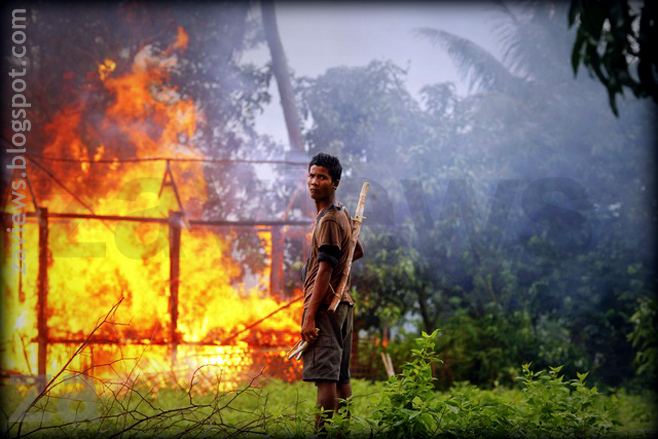
The latest violence erupted on 28 May, when he was found dead of a Buddhist woman who had allegedly been raped and murdered by three Muslims . Six days later, a crowd of Buddhists stopped a bus in which, they said, the culprits were traveling, killing ten Muslims. Two of the murderers were sentenced to death on Monday, while the third committed suicide in prison, according to Efe. Since then, groups of Buddhists and Muslims clashed in several locations in Rakhine, which left nearly 90 dead and 90,000 displaced , according to residents, and 50 dead and 60,000 displaced, according to the Government. Violence had declined since the declaration of state of emergency on 10 June, but last week left a balance of 67 dead and 95 wounded, according to dpa.

Violence in western Burma: the balance sheet amounted to 82 dead


At least 82 people were killed in violence this week between Buddhists and Muslims in western Burma, Saturday, Oct. 27 said a government official. Under condition of anonymity, the official said there had also been "129 injured"After several weeks of calm in the Rakhine State under a state of emergency since the first clashes in June, violence broke out again Sunday between ethnic Buddhist Rakhine and Rohingya, a stateless Muslim minority considered by the UN as one of the most persecuted of the worldThe previous report released by the media state reported 67 people killed and a hundred wounded and nearly 3,000 houses burned. Some 75,000 people were displaced by the June violence, the vast majority of Rohingyas, who still live in miserable conditions just outside of Sittwe in camps where they lack food and care. The new wave of fighting has driven thousands of other Muslims to flee.

Saturday, October 27, 2012

BURMA | Vilencia senctaria between Muslims and Buddhists Tragedy tests Rohingya

The NGO Human Rights Watch has urged the Burmese government to stop "immediately" the resurgence of sectarian violence that spans western Burma between Muslims and Buddhists which has caused at least 67 deaths in less than a week. The international organization has published satellite photos where you can see the complete destruction of a neighborhood in the city of Kyaukpyu , where the population resided in the Muslim Rohingya ethnic group . In the snapshots can be counted more than 800 buildings destroyed and houseboats. "Unless the authorities begin to address the root causes of this violenci to, only this conflict is likely to get worse, "he said in a statement Phil Robertson , deputy director of Human Rights Watch's Asia.

Government figures

State television reported last night that the Government had revised down the estimated death toll since unrest regrowth on Sunday to leave at 67 dead, 95 injured and nearly 3,000 homes destroyed. Spokesman Rakhine State (formerly Arakan), Win Myaing , where clashes occur, initially recorded in 112 deaths among Muslims and Buddhists. In an attempt to contain the clashes, officials kept the curfew in the village of Mrauk U and Minbya , the two places where the violence began then spread to other locations in this region located about 600 kilometers northwest Yangon , the former Burmese capital. The official spokesman said the central government had given the troops the order of the day and night patrolling six locations and dissolve through the use of force any public group consists of more than five people. The refugee agency UN said in a statement that at least 2,500 people of Rohingya have fled their homes in the region to go to the refugee camps in western Burma .

Stateless

These riots followed which broke out on May 28 in the same region and caused over several days at least 88 dead, most of the Rohingya Muslims. The trigger for that first wave of violence, during which 2230 houses were also destroyed and some 100,000 fled the villages, was the discovery of the body of a Buddhist woman raped and murdered by three Muslims. Some 800,000 Rohingya Muslims living in Burma , mostly in Rakhine, although authorities in this predominantly Buddhist country do not recognize citizenship and keep coming from neighboring Bangladesh. This community is not recognized stateless in Bangladesh , where some 300,000 Rohingyas are crammed into refugee camps.

Violence between Buddhists and Muslims killed more than 100 in riots in Burma

For days there is violence between Muslims and Buddhists in Burma.Join more than 100 people were killed. The riots are now available for the opposition under Aung San Suu Kyi to the problem. 
The prolonged for days of violent clashes between Buddhist and Muslim ethnic groups are reported to authorities in the west of Burma since 112 people were killed.Moreover, in Rakhine State nearly 2,000 houses were burned, such as government agencies announced on Friday.  More than 70 people, including ten children, were injured in the riots that take place between the communities of Buddhist Rakhine and the Rohingya Muslim. UN Secretary General Ban Ki-moon called on the government of Burma because of the "deeply disturbing" violence to "work to take urgent necessary steps to regain control of lawlessness to be." In a statement by President Thein Sein, which was published on Friday in the state-owned newspaper "Myanma Ahlin" warned against the consequences of the riots. "As the international community closely watching the process of democratization, such disturbances can tarnish the image of the country". Police and army would try to establish peace and security again, the report said. Moreover, being taken against any individual or organization, "the attempt to reignite the unrest."His foundation, the conflict in the status of the Rohingya. Although many of them have lived for several generations in Burma, they are in many places more than strangers from neighboring Bangladesh, steal the scarce land. They still live mainly along the border with Bangladesh and are not recognized as a distinct ethnic group of Burma. A multinational state, there are a total of 135 Burmese ethnic groups. Back in June at such excesses were 90 people were killed and about 3,000 houses were set on fire. Tens of thousands of people are living in refugee camps ever since. The violence broke out after the men of the Rohingya minority have been accused of raping a girl from the ethnic group of Rakhine. The riots are not only a problem for the government of Thein Sein, but also for cooperating with it in the democratization Oppositonsführerin Aung San Suu Kyi. The Nobel Peace laureate has been criticized for not sufficiently related to the oppression of the Rohingya position to have.

Thursday, September 20, 2012

Red carpet for Suu Kyi in Washington, historic meeting with Obama


Washington held the red carpet Wednesday for Burmese democracy icon Aung San Suu Kyi, with an unprecedented meeting with President Barack Obama and the delivery of a prestigious Congressional Gold Medal. President Obama, winner of the 2009 Nobel Peace will host for the first time the Burmese opposition leader, who received the award in 1991, said the spokesman for the White House, Jay Carney. This historic meeting is scheduled to 17H00 (21H00 GMT) and will be closed to the press. For Obama, the visit of Ms. Suu Kyi "can once again reaffirm our longstanding support his fight and struggle for many other democratic, fair and transparent in Burma," said his spokesman. In fact, the President of the United States in 2009 had supported the initiation of a process, so unthinkable, democratization of Burma. The military junta, which held that countries in Southeast Asia is for half a century, was replaced in March 2011 to a civilian regime of former generals reformers. The process was bloodless and Burma has changed its face, thanks to the release of hundreds of dissidents and the election of Aung San Suu Kyi as an opposition member. Washington ended in July, most of the restrictions on its investments in Burma, including gas and oil. A new ambassador has served since July, a first in 22 years. Aung San Suu Kyi in Washington since Monday for a three-week trip across the United States, where, as in Europe in June, she received a warm welcome as prestigious as a country where it is worshiped.
The most prestigious civilian award
She found Tuesday Secretary of State Hillary Clinton, she was warmly welcomed in his dilapidated house and mythical Rangoon in December 2011. Released in late 2010 under house arrest after spending 15 years deprived of liberty, the "Lady of Rangoon" called for the lifting of all sanctions imposed by Washington over the past two decades. Restrictions that had yet supported at the time to put pressure on the military in power. Clinton responded that he "rest (any) work" so that "the opposition and the government work for the unity of the country," the warning against possible "flashbacks". Before the White House, the opponent has at 15H00 (19H00 GMT) honors all U.S. institutions by going to Congress to see return his gold medal, the most prestigious civilian award in the United States. She was awarded in 2008 when she was under house arrest. However, wishing to maintain pressure on the new regime in Burma - whose official name is the "Myanmar" - Congress has extended the ban on August Burmese imports. Tuesday, Clinton was also worried communal violence between Buddhists and Rohingya Muslim minority in western countries, as well as ongoing relationship between Burma and North Korea. American tour of Aung San Suu Kyi coincides with the arrival of President Thein Sein of Burma, expected next week at the General Assembly of the UN, for the first time as head of state. The Center Strategic and International Studies (CSIS) in Washington pleaded for President Obama meets with Burmese at the same time that Suu Kyi, in order not to minimize his "courageous role" in the reforms.

Monday, August 27, 2012

In western Burma, the tension still high between Muslims and Buddhists


Some live in refugee camps without status others take refuge in monasteries and require protection. But if Muslims and Buddhist Rakhine State, in western Burma, share one thing, it is their refusal to live together. Two months after the outbreak of violence, which left dozens dead, among members of the ethnic Rakhine - Buddhist - and Rohingyas - a Muslim minority stateless - it remains in some villages in ruins and heaps of ashes. For those living in neighboring burned their respective homes. You Nawseema Har Fa says he left his village after seeing it go up in smoke. She now lives near Sittwe, capital of Rakhine State (formerly Arakan), under a state of emergency for almost two months. "We had no problem with Buddhists before. We do not quarrel. We lived together, we were talking about. We went to the market together," she said. "We are here primarily to protect children, or they might be dead there." They are some 70,000 displaced people around Sittwe, 50,000 and 20,000 Rohingyas Buddhists, police said, which could go in the border region of Bangladesh where access is still very limited. Rohingyas, considered by the UN as one of the most persecuted minorities in the world, living in camps and have little hope for improvement: the Burmese authorities do not recognize them as a legitimate minority and Bangladesh does not them. "There are no houses or shelters in their villages, they were all burned, that's why they are there," said Soe Myint, who runs the refugee camp Kaung Dokar, one of six Sittwe. The machine is packed violence after the rape of a woman who sparked Rakhine punitive operations in series. Nearly 90 deaths were recorded in June, according to an official report that NGOs feel undervalued. And if the authorities say they have regained control of the situation, several people were killed early August in incidents. "Terrorize the Bengalis" The Rohingyas are confined in camps, dependent on deliveries from the World Food Programme of the United Nations. "We do not have enough to eat, because we do not have the opportunity to go to Sittwe to buy what we need," said Abu Shukur, a displaced person. Faced with attacks advocacy organizations Human Rights and some Arab countries, the government defends its forces. But Human Rights Watch accused of having shot the Rohingyas, to have engaged in rape and sometimes have attended no act of violence. A Sittwe is huge resentment among Buddhists often outraged aid channeled towards those they consider to be illegal immigrants and they call the "Bengali" or "kalars", a pejorative term deeply all Muslims. "Political parties, some monks and individuals accentuate ethnic hatred," denounced President Thein Sein in a report to Parliament on August 17. "The Rakhine constantly thinking terrorize Bengali Muslims living in the country," he lamented, adding that the two communities suffering from the situation. He recently announced the establishment of a new committee to suggest solutions for "peaceful coexistence". But his task is immense. "We knew who burned our houses," said Saw Saw a Rakhine moved."But if Rohingyas come from abroad, then it will be even worse."

Wednesday, August 15, 2012

Slaughter of Muslims in Burma


In June 2012 hundreds Burmese Muslims have been butchered, and many more injured and made homeless in Burma as a result religious intolerance by the Buddhist majority. The Burmese military government, far from trying to resolve the problem and protect the minority, has been silently conniving with the rioters by creating greater hardships for the Muslim minority. The reason of this June 2012 riot is unknown except for the periodical outbursts of the Burmese Buddhists to show their might and vent their anger on the helpless minority. It is commonly accepted that the June 2012 massacre of Burmese Muslims was intentionally orchestrated by the rioters in collaboration with the government. Yet the world, including the UN, is conveniently silent. The brazenly hypocritical and unscrupulous woman, Aung San Suu Kyi, is very prompt at accusing the Burmese military of human rights violations when she is under house arrest. But she finds nothing wrong when the military helps the Buddhist mobs to murder the innocent Muslim minority of her country. As in India, anti-Muslim riots are nothing unusual in Burma. Violence in Burma against Muslims have been erupting periodically since the 1920s based simply on religious intolerance by the Buddhist majority. The Muslims of Burma mainly belong to the Arakan state in western Burma. They are known as Rohingya or Burmese Muslims. The term "Rohingya" has been derived from the Arabic word "Raham" meaning sympathy. Muslim settlements began being established in the Arakan province of Burma since the arrival of the Arabs in the 8th century. Presently about 800,000 Rohingya live in Burma. The United Nations describes them as "one of the world’s most persecuted minorities." Yet it has never bothered to help them. Religious freedom for Muslims in Burma has been systematically curbed. In the post 9/11 era, random accusations of "terrorism" against Muslims have become a common form of persecution and harassment by Burmese Buddhists. Burmese Government does not consider Rohingya Muslims as citizens and they are hated by the Buddhist majority. Rohingya Muslims in Burma have long demanded recognition as an indigenous ethnic group with full citizenship by birthright. But the Government regards them as illegal immigrants from neighboring Bangladesh and denies them citizenship. "Nobel Prize winner," Aung San Suu Kyi, does not consider Muslims as citizens. Speaking at London School of Economics meeting on June 2012 during her visit to the UK, she said "Rohingya Muslims should not be considered citizens." Later during her press conference at Downing Street, she did not condemn the killings of Rohingya Muslims taking place in Burma. Instead, she simply said that this "ethnic conflict should be investigated and dealt with wisdom." It wasn't just an insufficient response but a very shocking one from someone supposed to have won a "Noble Peace Prize." The notorious master hypocrite and undercover CIA agent, Dalai Lama, continues to globe trot without mentioning a single word of the dangerously growing Buddhist intolerance in Burma, Thailand, Tibet and across the world. Such intolerance and persecution invariably result in resistance by the oppressed. Many Muslims have joined armed resistance groups, fighting for greater freedom in Burma. On June 3rd 2012, eight Muslims returning to Rangoon in a bus after visiting a Masjid in the Arakan province were attacked by a mob of hundreds of Buddhists and slaughtered brutally. An eye-witness reported that after the mass murder "the culprits were celebrating triumph spitting and tossing wine and alcohol on the dead bodies lying on the road." "These innocent people have been killed like animals," said Abu Tahay, of the National Democratic Party for Development, which represents the country’s much-persecuted stateless Muslim Rohingya community. The Rohingya Muslims of Burma have continued to suffer from human rights violations under the Burmese junta since 1970s. Over the years thousands of Rohingya refugees have fled to neighboring countries like Thailand, Indonesia and Bangladesh etc. Even as refugees they have been facing hardships and have suffered persecution by the Thai government. In February 2009, a group of 5 boats packed with Burmese Rohingya Muslims were taken out and abandoned in the open sea by the Thai army. Four of these boats sank in a storm and one was washed ashore near the Indonesian islands. The few survivors who were rescued by Indonesian authorities told horrific stories of being captured and beaten by the Thai military and then abandoned at open sea. Being "peaceful" or "humble" (as claimed by their biased supporters) is a far cry concerning the Burmese Buddhists. Their vindictive temperament prowls for vendetta, waiting to use even the most insignificant occurrence as an excuse to perpetrate violence on Burmese Muslims. At any time, if there's some ethnic disturbance between Muslims and Buddhists/Hindus in any other country, the Burmese Buddhists waste no time going on a murderous spry killing the Muslim minority in Burma. If there is the slightest of trouble between Muslims and non-Muslims in Indonesia, it's taken as a pretext to kill Muslims in Burma by Buddhist mobs. The destruction of the statues in Bamiyan (Afghanistan), created an immediate excuse to commit violence against Muslims in Burma in 2001. The firebrand Buddhist monks demanded a Muslim masjid to be destroyed in retaliation. Mobs of Buddhists led by monks, vandalized Muslim-owned businesses and property in Burma, and attacked and killed Muslims in Muslim communities. Gruesome images of murdered Rohingya Muslims in the recent June 2012 riots in Burma have been circulated on websites, resulting in protests in several Muslim countries and by various human rights activists around the world demanding justice & protection in Burma for the minority, but has fallen on deaf ears as usual, getting little or no coverage from mainstream news channels.

PLEASE SEND THIS AROUND. THE WORLD HAS THE RIGHT TO KNOW THE TRUTH.

Sunday, August 5, 2012

Saturday, August 4, 2012

Burma - Government forces targeting Muslim Rohingya

The Human Rights Watch in a report released today that the Burmese security forces committed acts of murder, rape and mass arrests in the right of Muslim Rohingya after it failed to protect them and protect Buddhist Alerakan during the events of sectarian violence, bloody western Burma in June / June 2012. Resulted in government restrictions on humanitarian access to areas housing Rohingya to the suffering of more than 100 thousand people displaced and homeless of the urgent need of food, shelter and medical care. report, " the government can stop what happened: the sectarian violence and abuse that followed in the state of Arakan in Burma , "which published in 56 pages, describes how the Burmese authorities failed to take necessary actions to stop the growing tensions and the outbreak of sectarian violence in the state of Arakan. Although the Army is finally able to contain gang violence in the state capital, the city of Sittwe, the witnesses said Alerakan and Rohingya Human Rights Watch that the government forces and stood watching while the elements of the Muslims and Buddhists are attacking each other, they start destroying villages and committing an unknown number of the killings. said Brad Adams , Asia director at Human Rights Watch: "failed to Burmese security forces to protect Alerakan and Rohingya from each other, and then launched a violent campaign and mass arrests against the Rohingya. the government claims it spent on the work of ethnic fighting and violations, but the events Last in the state of Arakan shows the continued persecution and discrimination under the auspices of the government. " said Human Rights Watch that the Burmese government to take urgent steps to stop the violations committed by government forces, in order to ensure the flow of humanitarian assistance, and allow international observers independent to visit areas affected by the events to investigate the violations.

Report is based on 57 interviews took place during the months of June and July with members affected by the events of Alerakan and Rohingya, and others in Burma and Bangladesh , where he is seeking Rohingya asylum away from violence and abuse. erupted violence in early June after the appearance of news spread in 28 May / May on exposure of a woman of Buddhism Alerakan of rape and murder in the town of Ramera by three Muslim men. Details of the crime emerged at the local level in the form of publications, enticing, and in the June 3 a large group of villagers from Alerakan, when Tongob area, off the bus and killed cruelly ten Muslims were on board the bus. Confirmed by Human Rights Watch that local police forces and the army in the vicinity of the place did nothing and stood watching without interfering. In response to what happened, the thousands of Rohingya in the June 8 rioted in the town of Mongdao after Friday prayers, killing an unknown number of Alerakan, smashing homes and property of many of the Arakan. Then spread the violence between Rohingya and Alerakan in Sittwe and the surrounding areas. Gangs of Alerakan and Rohingya both raided villages and neighborhoods have never witnessed any events, killing people and destroyed and burned houses, shops and houses of worship. In the presence of government security little or no to stop the violence, armed people themselves with swords and spears, sticks and metal bars, knives and other makeshift weapons.And resulted in media reports Althjieh anti-Muslim and negative publicity against them at the local level to fuel the violence. A large number of Alerakan and Rohingya, who spoke with Human Rights Watch that the authorities were able to stop the violence and avert what subsequent violations. there is a man of Alerakan at the age of 29 years and older man of the Rohingya, told Human Rights Watch, both in private , but exactly the same words: "The government can stop what happened." Activity in the end led the Burmese army in Sittwe to stop the violence. But on June 12 Gangs of Alerakan burned the homes of an estimated ten thousand Muslims of Rohingya and other Muslims, in the largest district of the Muslims in the city, while the police forces and the forces of "color Thain" paramilitary firing live ammunition on the Rohingya. man said of Rohingya from Sittwe at the age of 36 years, told Human Rights Watch that a gang of Alerakan "began to burn houses. when people tried to extinguish the fire, paramilitary forces fired at us. The group beat people with sticks great." Another man said of Rohingya from the same neighborhood: "I was at a distance of few meters. You in the street. I saw them shoot at least six people, a woman and two children and three men. Police took the bodies and kept off it." in Sittwe, where half the population of Arakan and the other half Muslims, most Muslims fled or were forced from the city forced out of them, which raises questions about whether the government will respect their rights to return to their homes. Identified by Human Rights Watch that the center of the state capital, which was characterized by pluralism in the past, has become divided and devoid of Muslims to a large extent. In northern Arakan State, the army and police forces and border guards "Nasaka" forces and "color Thain" quasi-military, acts of murder and mass arrests and other abuses against the Rohingya. They cooperate with the population in the region Alerakan looted storage of food and luggage Rohingya value of homes. The border guards and soldiers opened fire on crowds of Rohingya as they tried to flee the violence, leaving a number of dead and injured. said Brad Adams: "If the atrocities committed in the state of Arakan had been signed before the start of government reforms, the reaction was International becomes quick and strong. " He continued: "But it seems that the international community blinding tale romance that are recited on the changes large and the root in Burma, has signed a new business deals and the lifting of sanctions while continuing the violations." Since June, the government has detained hundreds of men and boys of the Rohingya, etc. remain in detention in isolation from the outside world. And authorities in the state of Arakan, north of the country's long history of torture and ill-treatment of detained Rohingya, according to Human Rights Watch. In the town of Molim coastal South, there were reports about the arrest of 82 people from the Rohingya in late June, and sentenced to years in prison for violating immigration laws. said Brad Adams: "The authorities of Burma to immediately declare the details of Rohingya detained, and allow the arrival of relatives and organizations humanity to them, and to release any person who is not accused of a crime recognized by international law under the credible evidence. " He added: "This is a test of the Government's avowed commitment to reform and the protection of fundamental rights."Burmese Nationality Act of 1982 prevents the granting of citizenship of the Rohingya Burmese, and their numbers estimated at eight hundred thousand to one million people. In July 12th, the President said the Burmese Thein Sein said that "only solution" to the sectarian violence is the expulsion of Rohingya to other countries or to camps supervised by the UN agency for refugees.president said: "I will keep them if it had accepted other countries receive them." law distinguishes the Burmese and policies in place against the Rohingya in Burma, as they are in violation of their rights to freedom of movement, to education and work. Usually refers officials Burmese government to Rohingya under the name "Abanngaleon" and "so-called Rohingya" or the term "Kalar" humiliating, face Rohingya prejudices and discrimination of Burmese society in general, and are prejudice and discrimination, even defenders of democracy since a long time, and minorities other ethnic persecution suffered in turn from the state of the Burmese since long periods. there a new committee for human rights in Burma - headed by Win Mra, a Alerakan - did not play an active role in monitoring violations of Arakan State, according to Human Rights Watch. In the assessment was issued on July 11 the results of sectarian violence, did not address the Committee to the occurrence of any violations of government, and claimed that it is meeting all human needs, and did not talk about the problem of citizenship of Rohingya and persecution against them. said Brad Adams, "the Burmese government to review the Nationality Act quickly to put an end to discrimination against the Rohingya government. " He continued: "You can not claim that President Thein Sein all sincerity that it supports human rights while demanding the expulsion of the population because of their race or their religion." said Human Rights Watch that the sectarian violence led to the urgent humanitarian needs of each Alerakan and Rohingya.Alerakan local organizations, and supported by donors, mostly Burmese, and provided food, clothing, medicine and shelter for the displaced Arakan. In contrast, the ability of Rohingya people to go to markets and access to food and work remain a threat or is almost impossible, and there are many of them in hiding for weeks. government restricted access to affected areas, especially areas of Rohingya, leading to paralysis of humanitarian intervention. Workers were the United Nations and relief organizations to arrests, threats and intimidation of the population of Alerakan who see aid workers biased the Rohingya. Led government restrictions to isolate some areas, such as the villages of South Mongdao, for humanitarian relief organizations full. said Brad Adams: "The authorities should provide immediate capacity and access for humanitarian agencies to reach all affected populations and they must start work to prevent acts of violence of this type in the future between the two groups. " He continued: "The government should help the two groups the services refer to the homes and to ensure that can all displaced people to return to their homes and live in safety." since the violence in June fled thousands of Rohingya to Bangladesh bordering Burma, where they face attempts to return to Burma from the Bengali government, in violation of international law. Witnessed by Human Rights Watch on the arrival of men, women and children from the Rohingya to a beach Bangladesh and saw how they started begging the authorities to let them spend the inside, were brought to the sea in boats heirs during the season of heavy rains, exposing them to the risk of drowning and starvation in the sea or persecution in Burma. It is not known death toll from these returns. Those who managed to enter the Bangladesh living in hiding, without the ability to access food, shelter, or little protection.that Bangladesh is committed to open its borders and grant Rohingya temporary shelter at least, to become a safe return, consistent with international standards of human rights. Called Human Rights Watch, the Governments concerned to assist Bangladesh in this matter and invited them to put pressure on Burma and Bangladesh to stop the violations and ensure the safety of Rohingya. said Brad Adams: "Bangladesh violate its international obligations as re asylum seekers harshly so to boats heirs to return them to the open sea" .